In the previous article, we looked at how DeFi is steadily — if not disruptively — exposing the cracks in Wall Street’s foundation. As the inefficiencies of Traditional Finance come into sharper focus, capital is beginning to flow into decentralized alternatives.
Transparency, permission-less architecture, and execution speed aren’t just ideological wins — they’re practical advantages that are reshaping how value moves, and it actually moved in our case.
But, Why Are We Talking About Exchanges?
At the heart of every financial system — whether it’s a centuries-old marketplace or a modern stock market — there’s always been one constant: the exchange.
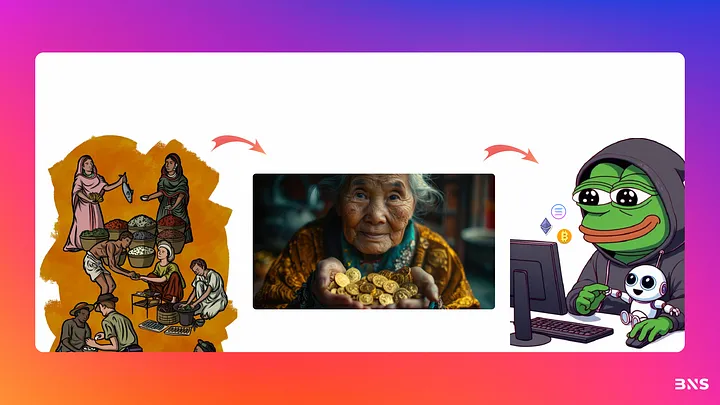
It started with simple barter systems, where people traded grain for cattle or salt for fabric. Fast forward a few thousand years, and now we’re watching tickers on the NASDAQ, LSE, or BSE, tracking billions of dollars flowing through global markets every day. Exchanges have always been where markets come alive — where value is priced, traded, and discovered.
Traditional exchanges have done a lot right. They’ve handled massive transaction volumes, connected capital across continents, and shaped the financial world we know today. But let’s be honest — they’ve also come with baggage.

Lack of transparency, sluggish settlement times, layers of middlemen, and barriers to access have made these systems more exclusive than efficient. The machinery works, but only if you’re inside the club.
And that’s where things started to shift.
When Decentralized Finance — DeFi — entered the scene, it didn’t just propose new financial tools. It posed a question: What if we could rebuild the entire exchange system — without the gatekeepers?
At the center of that rethink were two types of platforms: Centralized Exchanges (CEXs) and Decentralized Exchanges (DEXs). They both promised access to crypto markets, but how they delivered on that promise couldn’t be more different.
Let’s break them down — one at a time.
The Big Decision: CEXs or DEXs?
Another Day, Another Article, Another Story.

Let’s say your name is Harry Potter, and you’ve just arrived at Hogwarts. Hagrid has given you some magical coins — and they’re powerful. They can be traded, swapped, or even multiplied — but only if you choose the right house.
Just like in the movie, you’re to be sorted into houses. But here, we only have two: Gryffindor (Decentralized) and Slytherin (Centralized). (The reputation of the house precedes!).
Though unlike the movie, you have the privilege of choosing your house.
If you choose to take a step toward Slytherin (the Centralized House), the path is clean, paved, and well-lit. There are tall, gleaming towers whispering things like “Fast Trades Here!” and “24/7 Customer Support!” Then, a helpful — but shady-looking — wizard in a green suit greets you at the gate.
“This way is safe,” he says. “Give us your magical coins — we’ll keep them for you. You won’t have to worry about a thing.”
Now listen to me — the moment someone says trust me, that’s the moment I trust them the least.
Back to the story. For a while, it works. Your coins are easy to trade. You know what’s happening with them, how they’re multiplying and all. You can even trade large amounts without shaking the system. But soon, you start noticing fine print carved into the walls.

Turns out, you don’t actually own your tokens anymore. They’re sitting in a Goblin Vault you can’t access directly. And while goblins are trustworthy — well, that’s in the story, right? What if the tower decides to lock the door? Or worse, it gets attacked — and you’re left outside, empty-handed.
Stressful, isn’t it? Maybe you should’ve chosen the other house.
A New Approach? Perhaps a Decentralized One!
In December 2021 alone, centralized exchanges lost $196 million to hacks and exploits. In 2022, that number ballooned to over $735 million. And in 2023, even after all the headlines, they still bled close to $600 million.
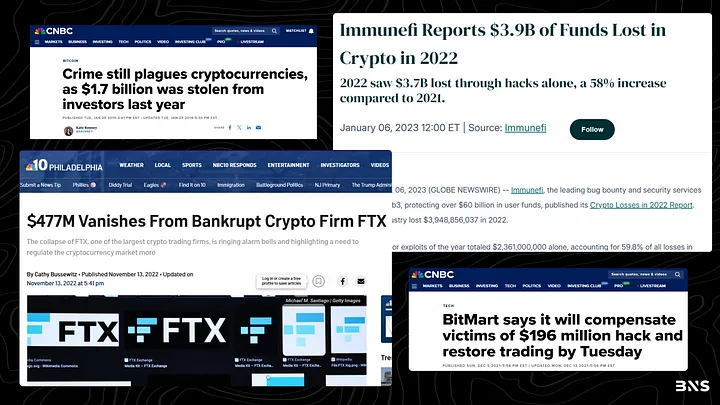
After every breach or mishap, almost every CEX echoed the same line:
“Your funds are safe with us.”
But in a space built on self-custody and transparency, that kind of reassurance stopped carrying weight.
The response wasn’t just skepticism — it was a shift in direction. Enter Decentralized Exchanges (DEXs) — platforms designed to remove trust from the equation entirely.
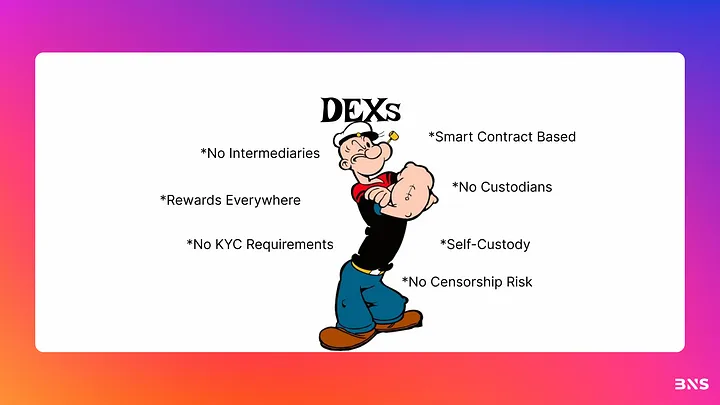
No intermediaries. No custodians. No centralized choke points. Just smart contracts and self-custody.
With DEXs, users retain full control of their assets. They connect their wallets, initiate a swap, and the protocol executes the trade — all on-chain, all transparent. It’s not about trusting a platform anymore. It’s about trusting the code.
So, there are a few key players in a decentralized exchange — the liquidity providers, the users, and the protocol itself. We’ll get into all of them in the next article. But before we do, let’s take a quick step back and ask:
Are DEXs really the future? Or people are choosing it, just because they have no other option!! 🤔
What’s Next: Cracking Open the AMM Black Box
In the next article, we’re diving into the mechanics.
- What exactly is a liquidity pool?
- How do CFMMs like Uniswap’s CPMM actually work?
- What’s the deal with concentrated liquidity, TWAPs, and tick ranges?
- And why does all this matter if you just want to swap tokens?
Trust me — the magic is in the math. And once you see it, you’ll never look at a swap the same way again.
See you in the next one!
Originally published on Substack, 30 June 2025.